
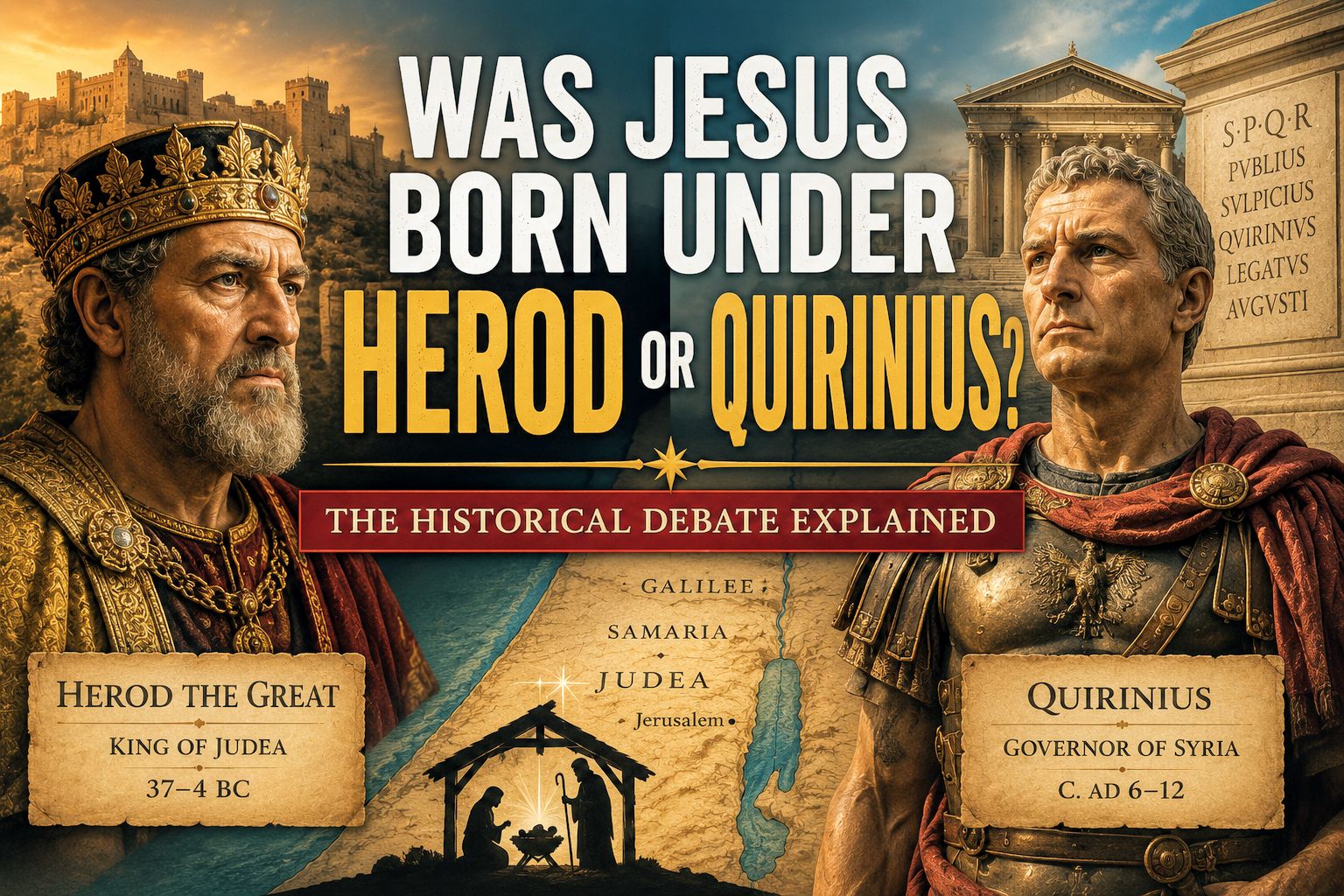
Sometimes, the scriptures read contradictorily. The story of Jesus’ birth under Herod and Quirinus is one of the most confusing subjects in Scripture. Matthew chapter 2 could be considered, at a surface level, the literal opposite of the book of Luke chapter 2, without a thorough analysis of the historical development of the time.
Most Christians never notice what appears to be a historical conundrum in the birth narratives of Jesus. Matthew claimed that the birth of Jesus took place during the reign of King Herod with a significant obvious proclamation of the killing of young children and a prophecy written by Jeremiah came alive, “In Rama was there a voice heard, lamentation, and weeping, and great mourning, Rachel weeping for her children, and would not be comforted, because they are not.” and Luke reported that Quirinus was the governor of Syria at the time, with another famous world tax under his watch. This was to drive a fulfilment of prophecy that Jesus shall be born in Bethlehem, David’s city, the most significant part of the world.
While it is natural to detect those discrepancies. But, taking things into account balances the inappropriateness of the heart towards the Word of God. The two accounts standing in total converse with each other have a peculiar reason. While Matthew specifically appeals to the Jewish minds with Jewish narrations about Jesus. The book of Luke gave accounts of the parts of the Gentiles, appealing to the Gentiles’ minds. Hence, God’s balanced equation to mankind.
What exactly was the problem with the birth of Jesus from the accounts? Herod appears to have died years before Quirinus’ famous tax took place. Has the Bible made historical blunders? What is more to the story? For years down the lane, scholars, historians, skeptics, and some Christian leaders have wrestled with this question. Understanding the historical debate not only illuminates the historical setting of Jesus’ birth but also helps us to appreciate that these are not shrouded complexities but matters to be understood.
Historical Dual Roles Which Herod and Quirinus Could Have Had at Jesus Birth
Herod the Great, had the reserved power to command territorial forces, security, and defence. Ordering the death of babies at Jesus’ birth is no error to his historical roles in Bethlehem. While Cyrenius (the Greek name for the Roman official Publius Sulpicius Quirinius) held a grand higher overall hierarchy rank in the Roman Empire. Herod was like a client king of Judah with some sovereignty. As a client king, (rex socious) and possessed the power of life and death, (ius gladii). This political logistics is a proper calculation of what has taken development. While Matthew took the portion of Herod in relation to the Jews the writer of the gospel of Luke accounted from the Gentiles’ narration. All of these for a balanced perspective.
Was it Historically True That Herod and Cyrenius Had A Distinct Timeline?
Roman Augustus an adopted title for Gaius Octavius happened to be the most powerful man on earth at the time cutting across Jesus birth. A position of decree that commands the whole world to the knees of a single guy for a tax. But the census had to be taken first. Roman had taken the world into its submission. It was the decree made at this time that took Jesus’ parents from their preliminary base in Galilee down to Bethlehem of Judea. The single command put Jesus’ parents into an uncalculated stress. Imagine the kind of distress the pregnant woman would have passed through on the seventy-mile journey.
Interestingly, while the Roman Empire’s lordship captures the world in its might. Caesar would have thought he had all the power, not knowing he was a Divine Puppet, doing the ordinance of Heaven. Micah 5:2 must be fulfilled. Yet, none, including the parents of Jesus were conscious of what we made them go to Bethlehem or see the need to go to the city to give birth. A journey of hours now and days then.
There are some perceived conclusions that the gospel of Luke could not have been divinely inspired due to inaccuracies. Cyrenius ruled over Syria something like 6 A.D., really ten years after the actual birth of Christ, because He was born four years before the change of the calendar from B.C. to A.D.” These said that Cyrenius was Governor of Syria, which included Palestine, for several years, from A.D. 6. This taxing could not have taken place in his time if it took place at the time when Christ was reputed to have been born. It was thought that Luke had misinterpreted this census with that under Cyrenius, at 6 to 7 A.D. When he became governor the second time. Meanwhile, Luke maintained that in Acts 5:37. Jesus birth came during the days of the taxing. Historical account accurately describes the timings of Cyrenius being governor of Syria before that, under the reign of Augustus, from B.C 12 on to B.C 3. It was patently that Luke was historically correct to sit the Census in his record, taking place in the given timeline.
In Matthew, King Herod is mentioned to picture the relationship of Jesus’ birth with the Jews. There are still some disagreements with the exact dates among chronologists on the image of King Herod’s dates. Luke explained how Jesus’ parents got to Bethlehem to fulfill prophecy. Matthew only told us Jesus was born in Bethlehem. The Gentile’s narration gave an insight into what led to the move to the geography of his birth. Stressing the mother who was great with the child. The other narration from the Jew took the course of another prophecy. How Jesus was to be terminated after been born.
In conclusion, the Holy Scripture is amazingly structured. Not with confusion or errors. But for an insight to be balanced. These are interesting because every sect and person would see from these versions of history which are connected to prophecy. Agelong prophecies, coming to play.
